

Diamond clarity grades how clean a stone is by measuring internal inclusions and surface blemishes. These natural marks are viewed under 10x magnification. The scale ranges from Flawless to Included, with higher clarity diamonds offering greater brilliance due to fewer visible defects.

When we talk about a diamond’s clarity, we aren’t just looking for “flaws.” We are looking at the diamond’s fingerprint. Almost every diamond has tiny natural birthmarks formed deep within the earth. The Clarity Scale measures the size, number, position, and visibility of these features under 10x magnification.
These are the rarest and most expensive diamonds.
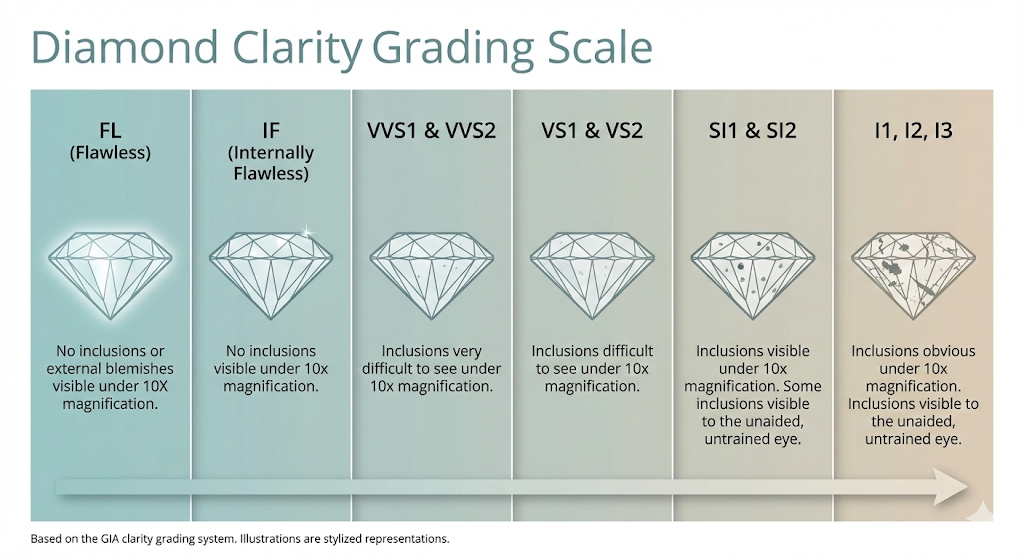
FL (Flawless): The holy grail of diamonds. Under 10x magnification, a skilled grader can see absolutely no inclusions or blemishes. These are incredibly rare.
IF (Internally Flawless): These diamonds have no internal inclusions visible under magnification. They may have very faint surface blemishes, but to the naked eye (and even the untrained magnified eye), they look identical to Flawless diamonds.
VVS (Very, Very Slightly Included): These diamonds contain inclusions so microscopic that they are difficult for even a professional grader to find under 10x magnification.
Why buy this? If you want a diamond that guarantees absolute purity to the eye but want to pay slightly less than the price of a Flawless stone.
This is often the most recommended category for high-quality engagement rings.
VS (Very Slightly Included): Inclusions are visible under 10x magnification but are characterized as minor.
The Bottom Line: You generally cannot see these imperfections with the naked eye. To your partner, a VS diamond looks pristine, but it costs significantly less than a VVS or Flawless stone.
SI (Slightly Included): Inclusions are noticeable under 10x magnification.
The “Eye-Clean” Factor: This is tricky territory. Some SI1 diamonds are “eye-clean” (meaning you can’t see the flaw without a microscope), while others have visible black spots or clouds.
Why buy this? If you inspect the stone carefully, you can find a beautiful diamond that allows you to maximize your budget for a larger Carat size.
I (Included): These diamonds have inclusions that are obvious under magnification and often clearly visible to the naked eye. These flaws can affect the transparency and brilliance of the diamond, sometimes making it look milky or hazy.
Diamond clarity is evaluated by professional gemologists using a detailed and consistent method. Each diamond is examined under 10× magnification with controlled lighting to identify and study its natural characteristics.
Size – Larger inclusions are easier to see and usually affect clarity more.
Number – A higher number of inclusions can reduce the overall grade.
Location – Inclusions near the center of the diamond (under the table) are more noticeable and have a greater impact than those near the edges.
Type – Different kinds of inclusions and blemishes affect appearance in different ways.
Visibility (Relief) – The more an inclusion contrasts with the diamond, the easier it is to detect.
This complete evaluation is then used to assign the diamond’s final clarity grade.

Clarity is an important factor in determining a diamond’s beauty, strength, and overall value. The number, size, and placement of natural inclusions can influence how a diamond looks, how well it performs, and how much it costs.
Clarity mainly affects:
Appearance and sparkle – Diamonds with noticeable inclusions may look less bright and lively.
Durability – Larger or multiple inclusions can weaken the structure of a diamond and increase the chance of chips or damage over time.
Light performance – Heavy inclusions can disrupt the way light passes through the stone, reducing brilliance and fire.
Although Flawless and Internally Flawless diamonds are rare and priced at a premium, many buyers prefer eye-clean or Slightly Included diamonds because they look beautiful to the naked eye and offer excellent value.