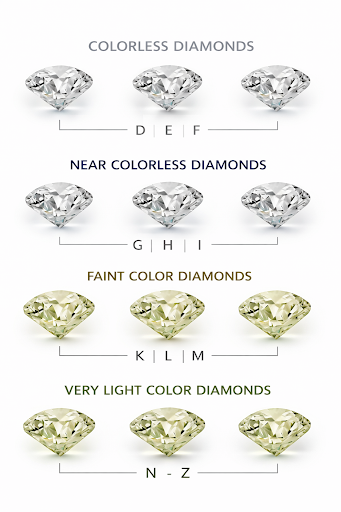
Color means the natural shade found in white diamonds. Most diamonds naturally have a small hint of yellow. The less color a diamond shows, the more rare and valuable it is.
To measure color, the diamond industry compares each stone to a standard set and gives it a letter grade from D (which means completely colorless) to Z (which shows a light yellow tint). Diamonds that don’t fall within the D–Z scale are very rare and are known as fancy color diamonds, loved for their strong and beautiful natural colors.

Diamonds graded D, E, and F are considered tintless. D and E diamonds show nearly no color at all, while F diamonds may have a veritably bitsy hint of color that’s generally only conspicuous when the diamond is viewed upside down. These bright, icy-white diamonds are extremely rare and are the highest quality when it comes to color. 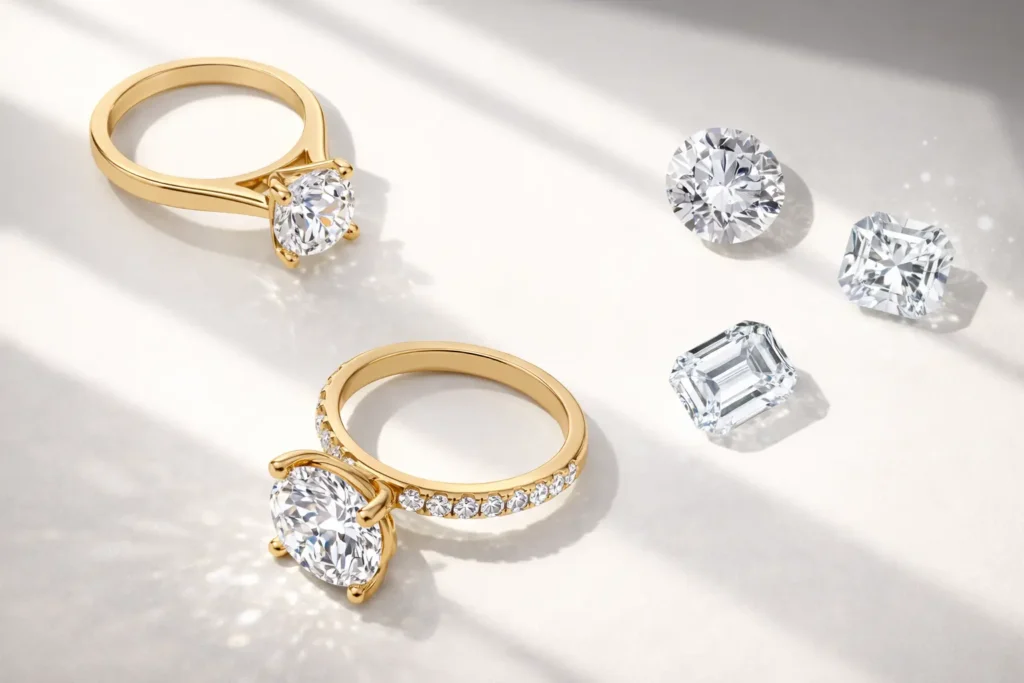 D Color Grade Diamonds
D is the top color grade and is given only to diamonds that are fully tintless. To the naked eye, D-color diamonds look exceptionally white and pure, with no visible shade of any kind.
E Color Grade Diamonds
E-color diamonds are also tintless and look nearly the same as D- D-color diamonds. In most cases, the difference between D and E can only be seen by a trained gemologist using special tools.
F Color Grade Diamonds
appear veritably analogous to D and E diamonds. Any slight color is extremely delicate to notice, and only a professional can generally tell the difference, especially when the diamond is viewed from the top.
Tintless diamonds are the rarest and most precious white diamonds because they represent the loftiest position of color quality. Since the differences between D, E, and F grades are so subtle, all three are excellent decoration choices and offer a beautiful, high-end look.
Near- Colorless Diamonds( G, H, I & J)
Diamonds graded G, H, I, and J fall into the near tintless
order. These monuments appear bright and white when viewed from over, with only a truly subtle warmth that is generally visible only in certain lighting conditions or when compared side by side with advanced color grades.
When set in pusillanimous or rose gold, any slight hint of color mixes naturally with the substance and is rarely conspicuous to the naked eye. This makes near- white
Diamonds are a popular choice for both beauty and value.
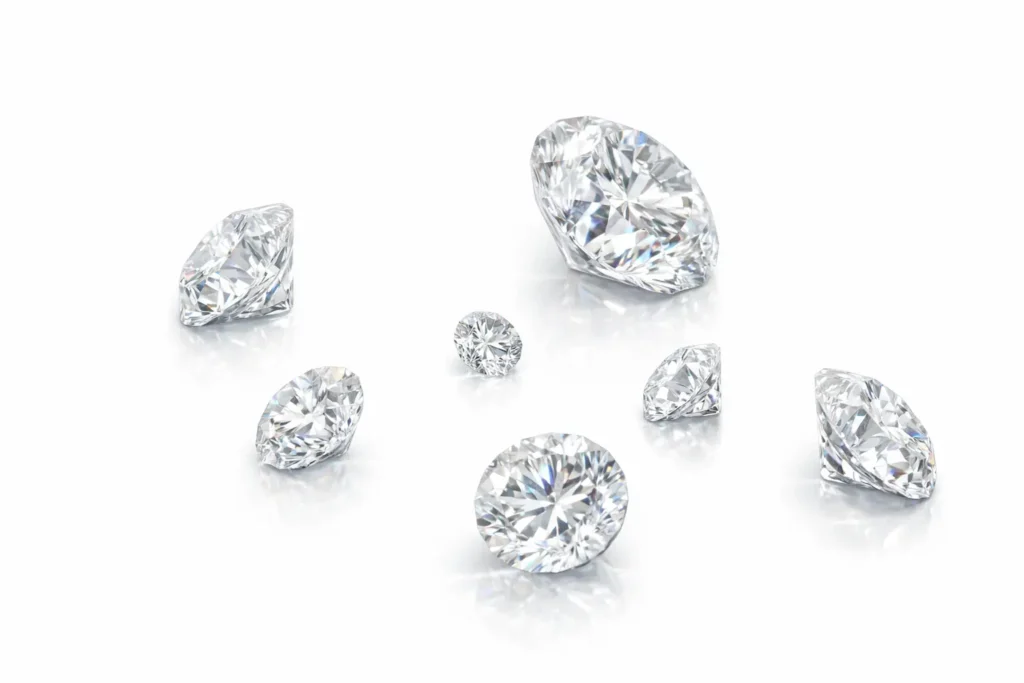
G color is the topmost grade in the near-tintless range. It appears nearly completely white
to the eye and offers an excellent balance between ultra-expensive appearance and price.
H color diamonds look white in normal viewing conditions. In bright light or against a pure white background, a truly soft warmth may be visible, but most people won’t notice it without close comparison.
I color diamonds show a gentle shade in strong lighting or when coming to advanced-grade monuments. On their own, they still appear bright and attractive, especially formerly set in jewelry.
J color diamonds have slightly more warmth than G, H, or I, but they still offer beautiful sparkle and clarity. Any color is subtle and generally unnoticed in everyday wear and tear and gashes.
Near-tintless diamonds are a smart choice for buyers who want excellent visual quality at a more affordable price. The differences between G, H, I, and J grades are truly small, yet the cost savings compared to fully white Diamonds can be significant.
These diamonds deliver outstanding brilliance, fineness, and value, making them a favorite option for engagement rings and fine jewelry.
In the GIA color grading system, diamonds are distributed by how important shade they show. While D, E, and F are” Tintless,” the K, L, and M grades fall into the knockout order.
K color This is the ground between” Near Colorless” and” knockout.” It has a veritably slight warm shade that’s frequently only visible when compared side- by- side with a whiter gravestone.
L color The warmth becomes further apparent. You’ll notice a soft,” candlelit”, unheroic or brown undertone.
M color These monuments have a definite, visible shade. still, in the right setting, they can look like” Champagne” diamonds, offering a stretch, antique aesthetic.
Fancy colored diamonds are special because they come in natural shades like pink, blue, yellow, and many more. These diamonds look very different from normal white diamonds, and that is why people love them so much.
White diamonds are usually chosen for their clear and colorless look. But fancy diamonds are all about the color. The stronger and brighter the color, the more rare and valuable the diamond becomes.
Fancy color diamonds are not graded on the regular diamond color scale. Instead, experts check the diamond’s color by comparing it with other reference stones. They mainly focus on how the color looks when the diamond is seen from the top, just like it appears in jewelry.

For white diamonds, less color is better. But in fancy diamonds, more color is better. Deep and rich colors are always more expensive and harder to find.
Fancy Color Levels (GIA)
GIA gives fancy diamonds different intensity levels such as:
Some colors like red, blue, and pink are extremely rare, so they are considered premium gemstones. Many people buy them not only for beauty but also because their value can increase over time. Fancy colored diamonds are a perfect choice for anyone who wants something unique instead of a traditional white diamond.